Storybook guide
Can AI Make a Consistent Pet Storybook? What to Check Before You Buy
The same pet can look different when the pose, setting, or illustration style changes. Learn which reference photos help and how to check the preview using two real sample books.
You want a storybook about your own pet, not just a cute dog or cat. A familiar white blaze, round face, or tail shape can make the difference between a pleasant animal illustration and a character you recognize.
AI can use reference photos and descriptions to guide a recurring character, but it does not guarantee identical markings or proportions on every page. Think of consistency as something to inspect, rather than a promise that every illustration will be an exact portrait. Here is a practical way to prepare your photos and evaluate the results.
What makes an AI pet character recognizable?
Consistency does not mean copying the same pose into every picture. A story needs movement, expressions, and different views. Look instead for a small set of recognizable traits that carry through those changes:
- Coat: the main colors, patches, stripes, and where they appear.
- Face: eye color, muzzle shape, ears, and distinctive markings.
- Build: body proportions, relative size, and tail shape.
- Story details: the same name, personality, and familiar belongings.
An illustration may simplify fine fur patterns or alter a small accessory. Decide which details matter most to you before generating the book. A missing defining patch may matter more than a slightly different background.
Compare Bella across three actual sample pages
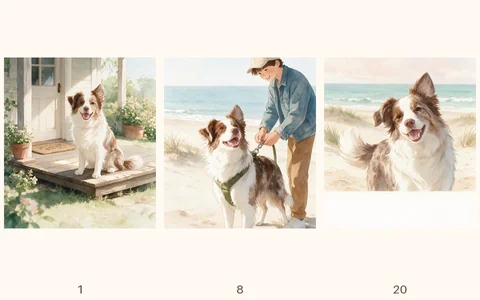
The image above combines pages 1, 8, and 20 from Bella’s Adventure, an existing sample on this site. They show Bella by a doorway, beside a person near the shore, and in a closer beach view. These are sample illustrations, not a controlled before-and-after test or a promise about your own book.
Follow the brown-and-white coat and the white blaze down the face. The framing, posture, and person in the scene change; some fur shapes and proportions also vary. Ask whether Bella remains recognizable to you, then open the complete Bella sample to compare more pages. A good-looking cover alone cannot show how a character holds together across a whole story.
A cat example: Milo’s face, coat, and familiar sofa
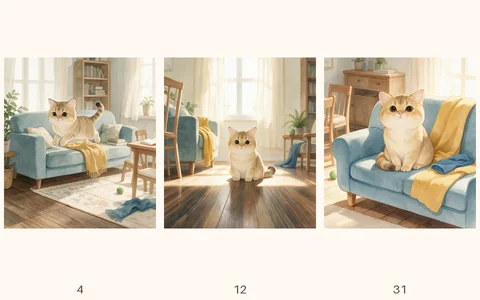
The image below combines pages 4, 12, and 31 from Milo’s Castle Adventure. The golden shaded cat moves between a sofa scene, a wider room view, and a closer seated view. Compare the round face, golden coat, and size of the head relative to the body.
The blue sofa helps connect the scenes, but a repeated background does not by itself prove character consistency. Look at Milo independently of the setting. These pages also show why you should expect interpretation: fur shading, expression, and proportions can change between images.
Choose reference photos that explain the same pet clearly
Start with three to five sharp photos from a similar period of your pet’s life. Include a face-level view, a side or full-body view, and a photo showing a distinctive marking. Aurflow AI accepts up to ten photos with a combined size of 100 MiB; more near-identical photos are not necessarily more useful.
Use ordinary light and avoid heavy filters, costumes that hide the coat, or photos where several animals overlap. If your puppy has grown or your cat’s coat has changed, say which stage the story should depict. Describe the important traits in plain language, such as “brown-and-white dog with a white blaze down her face,” instead of asking only for a cute dog.
Review the story first, then inspect the free illustration preview
Before confirming illustration generation, read the complete written story and check names, personality, and recurring details. If something important is missing, revise the source memories and regenerate the written story before confirming it. This is the point to clarify the input; the illustration preview is not a page-by-page editing tool.
The first four illustrated pages are free to preview. Compare them side by side on the device you will use to read. Check the face and coat first, then proportions and accessories. Read the narration too: a recognizable character should behave like the pet you described.
- Can I recognize my pet without relying on the name in the narration?
- Do the defining markings survive a change of pose or viewpoint?
- Are any changes small artistic variations, or do they alter the feature I care about most?
- Am I comfortable with this illustration style and its limitations?
A four-page preview cannot guarantee the appearance of all remaining pages. If you decide to buy, US$4.99 unlocks generation of the remaining illustrations in the 36-page digital book, with applicable taxes shown at checkout. The book is read online; printing and file downloads are not included.
A recognizable pet and a story worth keeping
A consistent character is one part of a good personalized pet storybook. The memories, tone, and little habits you contribute matter too. Give the AI clear references, inspect what it produces, and choose a result you enjoy as an illustrated interpretation of your companion.
For the full workflow, follow the photo-to-storybook guide below. You can also browse Bella and Milo from the homepage sample gallery before starting your own book.